

I feel I am arriving at something of a nexus: the start of a new academic year, a change of role and becoming Course Lead for the humanistic counselling and psychotherapy programme, and (hopefully) edging closer and closer to finalising publication for my book on humanistic psychotherapy. A kind of tabula rosa, one most figurally manifesting as thoughts on how to review and adapt some teaching for the MSc psychotherapy; itself providing a sense of blank slate as a new cohort begin in a little under a fortnight. Beginnings hold so much potential, a chance to re-visit, re-imagne, re-invigorate!
It was 10 years ago that I was stepping into my teaching role on Brighton’s therapy courses; 10 years ago that I was taking on the Course Lead for the Masters programme. The experience of deep dive then is not there as I take on another Course Lead; this time around feels remarkably different; I am different. And certainly my ideas on counselling and psychotherapy are different. Given, as Heidegger would say, we are always already becoming, it is natural that over 10 years there is change. And, I have no doubt that more change will come; and no doubt that my teaching and writing are what fosters change after change.
Ten years ago, and again in two weeks time, first thoughts toward teaching on the MSc were / are exploring with the trainees the nature of change through the humanistic lens. In a session alongside a colleague whose frame is the psychoanalytic and psychodynamic, we provide the trainees with an overview of therapeutic change: which in a psychotherapy, as distinct from counselling* concerns second order change. Over the years, my introductory lecture material has slowly shifted in its content: updates to ideas, and folding in new teaching and learning methodologies. This year – right now in fact – I am faced with an exciting prospect of how I present a more fundamental shift in me as a practitioner; one I lay firmly at the door of my writing these past 3 years.
On finishing my first book, one of my deepest learnings was how the book writes the author. This time around, there is a deeper appreciation of not only that, but how any book will invariably always be out of date! My mentor recently described this as the 90% phenomenon; so many of the ideas that have come into being because of the book don’t appear IN the book! In the next few months, as final edits are made, I am sure dilemmas (of what to update, what to leave as ‘out of date’ because of the practicalities of deadlines) will haunt me. While my ideas of therapy have changed in the last 10 years, they have taken a dramatic inflection in the last 3 years of researching, contemplating, living and breathing**, humanistic theory and existential-phenomenology.
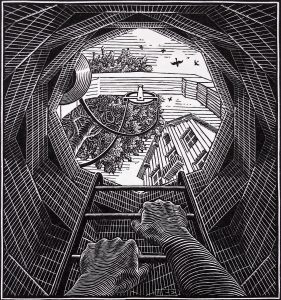 It isn’t that anything I have written, taught, practiced is not true…it’s more that it no longer feels complete. Writing and teaching help me become; carry forward. To not reflect this in my teaching would somehow feel incongruent; and I know that would show in my energy and delivery. So on some levels, whilst I could do with not bringing more work for myself (!), to not do so feels I am not honouring my becoming self, nor would I be living those felt-resonances with the likes of Escher, Eliot, and all those other artists, philosophers who speak and inspire on the importance of always unfolding, becoming; and decreating being the force behind creation.
Across the many modalities under the broad church of humanistic psychotherapy, the nature of change – the goal of therapy if you like – is described as congruence (person centred), autonomy (transactional analysis), and Gestalt (spontaneity). All point to a trajectory toward wholeness; yet each with its own terminology of processes: actualisation, decontamination, and self-actualisation. When I was first developing my teaching material, I was still very much telling the story of change from the perspective of the humanistic tradition emerging from a collection of independent thinkers (all living in a certain phase of history and particular geography); modalities like separate buckets of theory, brought together. This is in contrast to the psychodynamic tradition that can point to all its diverse forms originating and evolving from one thinker, Freud.
Developing a description of humanistic psychotherapy at the level of a paradigm means I am thinking outside the bucket!

When we are born, we are thrown into the world; one that is experienced as pre-existing. It is as if we are an object, landing on an object with many other objects. Not unlike the Biblical “fall”, we mistake ourselves as separate. We look around, “who are all these others?”, “what are we all doing here”?, and fundamentally “,”what are they to me?” and “what must I do to belong?”. And we do all sorts of things to belong. Undoubtedly shaped by our childhood environments, we shape shift; we learn strategies for surviving at the expense of our thriving. We contract away from our inherent wholeness. Ken Wilber in his text No Boundary, describes how such contractions result in a series of splits: the primary split of the world and organism, the separation of body and mind, and splits in mind itself (which in the humanistic tradition is expressed as parts of self). In more phenomenological languaging, we come to forget our embodied and embedded being-in-the-world. Counter to Biblical wisdom, there is an invitation to revisit our situatedness as being OF the world, not merely IN it! We don’t just walk superficially; when we tread, we leave a mark; we always and already imprint and impress on one another.
And why I enjoy descriptions in phenomenology of our immediate participation: the lived, relational process of being actively attuned, connected, and engaged with others within a shared lifeworld.
Coming back to the original “buckets”, for me each of the process descriptions come up a little short. Actualisation can present as somewhat individualistic (which again, we can understand as temporally and spatially relevant to post-war America), as can ‘autonomy’. The integration of Gestalt comes a little closer to a description of our totality; an expanding into rather than a direction of travel. As I explore a more dialectical movement at the core of well-being, I am finding myself framing a client’s distress as an inability to dance between (not just fostering an awareness of) polarities. Phenomenologists like Marc Boaz have written of this capacity to dance as a movement of oscillation. As the huge tides of accident crash at our door, how much can we align with the alternation itself than what we alternate between? How can we, like Sisyphus, relate to the climb rather than the summit and being repeatedly floored?
Recognising the temporality and spatiality in which we make our lives
Re-claiming our nature as verbs rather than nouns
Existing not merely existence
Phenomenologically, this comes in the descriptions of dimensionality and the primacy of movement. We don’t just move linearly over the surface of the world; well being calls for an expansion not just into the depths of our being, it invites an expansion into our verticality, our horizontality. From intersubjectivity to trans-subjectivity.
Like lungs, we are in a constant dialogue across within and without. A living body (korper) and body as lived (Leib).
While I described this moment like a tablua rosa, of course I am far from arriving here as / at a blank slate. Just like our thrownness, the no-thingness holds within potential for being and becoming. We don’t come from no-where, we are always and already, embodied and embedded: even if we think of that as the biology of our being (human coming from human), or the history of our becoming (the story across generations and what we inherit).
———————————–
*arguably, as discussed in my forthcoming book
** that is only a minor exegarration!
Image attribution – thanks to www.magnific.com
Escher’s The Well